 Published: 1 Jan
2026
Published: 1 Jan
2026 5-min read




INTRODUCTION
Task 1: Introduction
Q. Get your notepad ready, and let’s begin.
A. simply click check button
Task 2: OSI Model
Q1. Which layer is responsible for end-to-end communication between running
applications?
A1. 4
Q2. Which layer is responsible for routing packets to the proper network?
A2. 3
Q3. In the OSI model, which layer is responsible for encoding the application data?
A3. 6
Q4. Which layer is responsible for transferring data between hosts on the same
network segment?
A4. 2
Explanation
Application Layer Functions:
- Interface between user and network
- Provides network services to applications
- Protocols - HTTP, FTP, SMTP, DNS
- This is where browsers, email apps, etc., communicate.
Presentation Layer Function:
- Data formatting
- Encryption & decryption
- Compression
- Protocols - SSL/TLS
Session Layer Functions:
- Establishes session
- Maintains session
- Terminates session
- Manages communication sessions between two devices.
Transport Layer Functions:
- End-to-end communication
- Port numbers
- Flow control
- Error detection
- Segmentation
- Protocols: TCP,UDP
Network Layer Functions:
- Logical addressing (IP)
- Routing
- Path determination
- Protocols:IP,ICMP,Routing protocols (OSPF, RIP, BGP)
Data Link Layer Function:
- MAC addressing
- Frame formatting
- Error detection (CRC)
- Switch communication
- Responsible for communication within local network (LAN).
Physical Layer Function:
- Transmits raw bits (0s and 1s)
- Electrical signals
- Cables and connectors
- Hardware level communication.
Task 3: TCP/IP Model
Q-1. What is the destination MAC address used in an ARP Request?
A-1. FF:FF:FF:FF:FF:FF
Q-2. In the example above, what is the MAC address of 192.168.66.1?
A-2. 44:df:65:d8:fe:6c (shown in terminal above)
Explanation:
Application Layer Function:
- Provides network services to applications
- Combines OSI layers 5, 6, and 7
- Protocols:HTTP / HTTPS,FTP,SMTP,DNS,SSH
Transport Layer Function:
- End-to-end communication
- Port numbers
- Flow control
- Error detection
- Reliable or fast delivery
- Protocols: TCP, UDP
Internet Layer Function:
- Logical addressing (IP addresses)
- Routing packets
- Path determination
- Protocols: IP, ICMP, ARP
Network Access Layer Function: (Also called Link Layer)
- MAC addressing
- Framing
- Physical transmission
- Works with hardware
- Combines OSI Layer 1 + 2
Task 4 IP Addresses and Subnets
Q-1. Which of the following IP addresses is not a private IP address?
- 192.168.250.125
- 10.20.141.132
- 49.69.147.197
- 172.23.182.251
A-1. 49.69.147.197
Explanation:
Private IP address ranges are:
- 10.0.0.0 – 10.255.255.255
- 172.16.0.0 – 172.31.255.255
- 192.168.0.0 – 192.168.255.255
Q-2. Which of the following IP addresses is not a valid IP address?
- 192.168.250.15
- 192.168.254.17
- 192.168.305.19
- 192.168.199.13
A-2. 192.168.305.19
Explanation:
In IPv4, each octet must be between 0 and 255. Among the given options, 192.168.305.19 is
not a valid IP address because the third octet is 305, which exceeds the allowed maximum
value. The other IP addresses fall within the valid range and are therefore correct.
Task 5: UDP and TCP
Q-1. Which protocol requires a three-way handshake?
A-1. TCP
Q-2. What is the approximate number of port numbers (in thousands)?
A-2. 65
Explanation:
TCP
TCP (Transmission Control Protocol) is a connection-oriented protocol that ensures data is
delivered accurately and in the correct order. It establishes a connection before sending
data, checks for errors, and retransmits lost packets. TCP is used when reliability is
important, such as web browsing, email, and file transfers.
UDP (User Datagram Protocol) is a connectionless protocol that sends data without setting up
a connection or checking for errors. It delivers packets quickly but does not guarantee
delivery or order. UDP is commonly used for real-time applications like video streaming,
online gaming, and voice calls, where speed matters more than perfect accuracy.
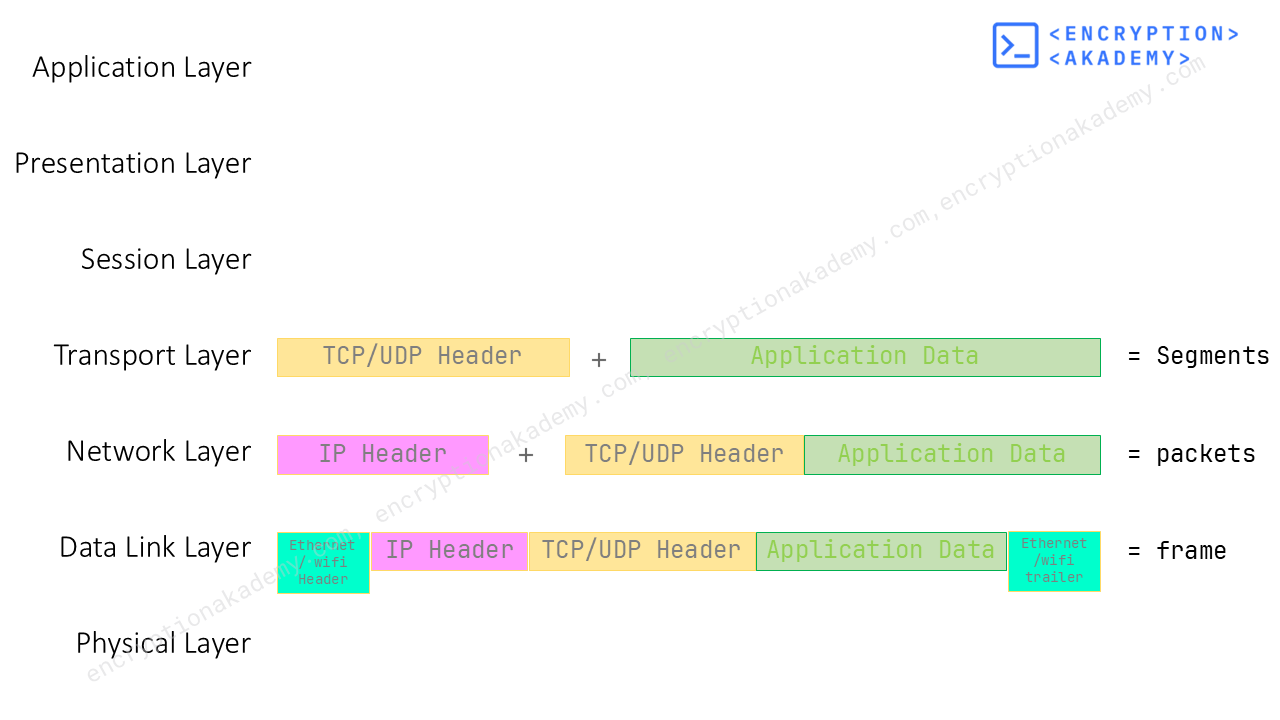
Task 6: Encapsulation
Q-1. On a WiFi, within what will an IP packet be encapsulated?
A-1. Frame
Q-2. What do you call the UDP data unit that encapsulates the application data?
A-2. Datagram
Q-3. What do you call the data unit that encapsulates the application data sent over
TCP?
A-3. Segment
Explanation:
The below image explains the Encapsulation.
Task 7: Telnet
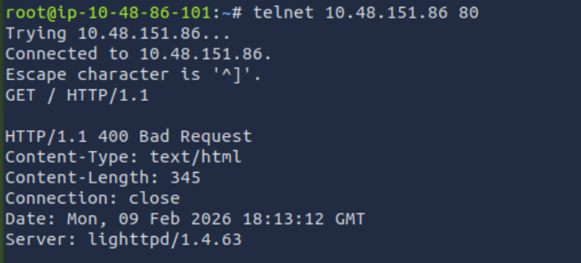
Q-1. Use telnet to connect to the web server on 10.48.151.86. What is the name and
version of the HTTP server?
A-1. lighttpd/1.4.63
Process
First run the command - telnet 10.48.151.86 80
U will see
Trying 10.48.151.86...
Connected to 10.48.151.86.
Next run the command - GET / HTTP/1.1
Press enter twice and you will see the following output
Q-2. What flag did you get when you viewed the page?
A-2. THM{TELNET_MASTER}
Process
Simply visit 10.48.151.86 on the browser you will see the flag.
Task 8 Conclusion
Q-1. Please note and remember all the concepts, network layers, and protocols
explained in this room.
A-1. Click check button